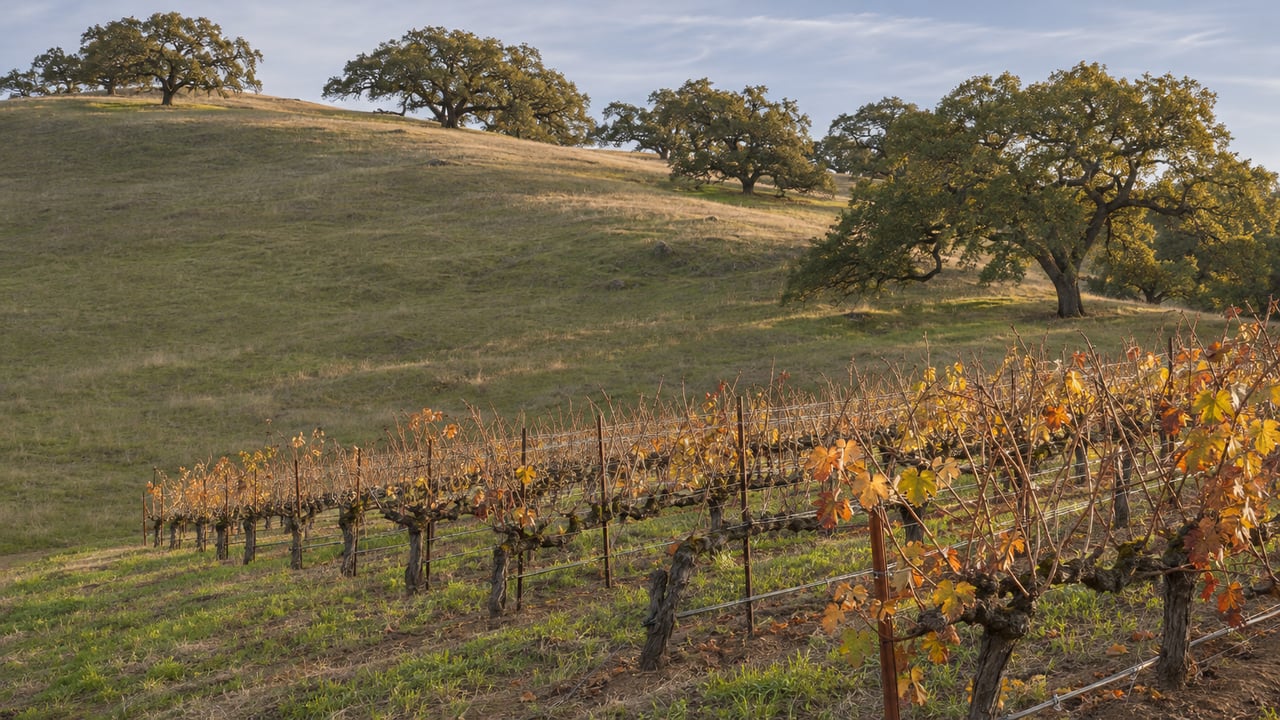
Buyers have long judged a vineyard near Geyserville by its appellation, soils, slope, water and the reputation of its fruit, and lenders have treated the land as collateral. Lenders now look at something else first. In its November 2026 banking report, WineBusiness Monthly said lending to wineries and vineyards is now driven almost entirely by earnings, because assessed values for inventory and assets have fallen sharply, and that "property values no longer serve as the funding mechanism."
For a buyer comparing the Alexander Valley and Dry Creek Valley acreage around Geyserville, this changes what the first question should be. The deciding variable is who buys the fruit, under what contract and for how long. Acreage and appellation still set the ceiling. The fruit contract now decides how close a property gets to it, and in the weaker part of the market, planted vines with no buyer can lower a property's value.
The lender reads the contract before the soil map
The WineBusiness report described valuation multiples of 3.5 to 5 times earnings before interest, taxes, depreciation and amortization. It called 5 times a best case and said 3.5 times "might be considered generous." It also set out a hypothetical case of a grower owing $6 million on a property once valued at $10 million and now valued at $4 million. It reported that banks have grown reluctant to extend annual operating loans to growers in that position.
For an acquisition, the bank's appraisal of a Geyserville vineyard starts with the revenue the fruit produces. A block under a multiyear contract with a credible winery produces a number a credit committee can underwrite. An uncontracted block of the same size and variety, on the same bench of the valley, produces an estimate of what the spot market might pay. WineBusiness reported that lenders now want to reduce exposure to vineyard borrowers with little collateral left. The cash a buyer must bring to close therefore depends on the contract as much as on the purchase price.
When the fruit has no home, the vines become a cost
The local evidence came out of the 2025 harvest. In November 2025 the Press Democrat reported that a Geyserville vineyard management firm had seen 75% of the 2025 fruit go unsold across the 250 Sonoma County acres it manages, after its long-term clients canceled their contracts. The same report said Central Valley producers such as Bogle and Bronco bought high-quality Sonoma County fruit that year because prices were so low.
The article also described a Dry Creek Valley Pinot Noir grower who removed half of his vines after the large wine company that had bought his grapes for 20 years canceled its contract. He said pulling the vines was cheaper than farming them for a season and paying $15,000 in crop insurance. Once a vine without a buyer costs more to keep than to pull, an acquisition model can no longer treat it as an asset.
American AgCredit's appraisal team reached the same conclusion for the whole state. In its Tangled Vines outlook, which reflects market conditions as of May 2026, the team wrote that buyers in the secondary market segments "attribute little to no value to the vines (or even a negative value due to removal costs)." Those buyers pay for the land based on its next use. The same report said lifestyle buyers often view vines on estate properties as "expensive landscaping." AgCredit reported that vineyards in marginal growing areas, or with vines nearing the end of their life in secondary areas, had lost as much as 50% of their peak value. It said vineyards with uncontracted fruit or site challenges were drawing little interest and had also fallen more sharply than the rest of the market. By the same estimate, even high-end properties in the prime areas of Napa and the Anderson Valley were at least 10% below peak.
Sonoma County's planted acreage reflects the same economics. The California Association of Winegrape Growers' LandIQ mapping counted 55,893 standing vineyard acres in the county as of August 1, 2026. It found that 3,523 acres, or 5.9%, had been removed in the 12 months before that date, as the Press Democrat reported from this month's Wine Industry Financial Symposium in Napa.
Who is still paying, and for what
AgCredit described a market that pays well for certainty and discounts everything else. As of the second quarter of 2026, investment buyers were the most visible group. They concentrated on high-end properties in the prime areas of Napa and Sonoma that guarantee income for at least several years through solid grape contracts or seller leasebacks. Young vines also drew interest because replanting is expensive. Where a seller could not provide assured income, those buyers held out for steeper declines. Our earlier piece on structuring leasebacks in Geyserville vineyard sales covers how sellers have answered that demand.
Wineries made up the other group still willing to pay full prices, but only in narrow cases. AgCredit wrote that wineries will "act and pay generous prices" when an adjacent vineyard becomes available, or a premier site known for vineyard-designated wines.
The most visible Geyserville transaction of the year fits that pattern. Sbragia Family Vineyards closed in 2024 after co-founder Ed Sbragia and his son Adam had run it as a Dry Creek Valley estate and wedding venue. In June 2026 it was acquired by Brookside Vineyard Company, owned by Tim Bacino, founder of Gen 7 Wines in Napa, according to the San Francisco Chronicle. The purchase price was not disclosed. The estate includes more than 50 acres of vineyards across Dry Creek Valley, and it is scheduled to reopen next spring as Brookside Winery. Four brands will make wine there, including Sbragia, and there are plans to add more. The Chronicle reported that Bacino is restoring vineyard land that had not received "a lot of love" since the closure, and is bringing in sheep and bees. Bacino told the Chronicle the property "allows me to expand our footprint." The buyer was a producer bringing its own brands to the estate, which puts the deal in the strategic-buyer category AgCredit described.
Few deals were closing anywhere else. Through mid-May 2026, AgCredit counted 19 completed vineyard sales across California. Five were in its Sonoma Prime segment, and average days on market was approaching 400. Sonoma appraiser Tony Correia described the gap between the two sides to the Press Democrat in May: "There's lots of sellers, and there's very few buyers."
Why the short 2026 crop matters for next year's contracts
If the contract sets the value, the next round of contract offers is the number to watch, and the 2026 harvest may have changed it. Sonoma County Winegrowers estimated the 2026 crop at 35% to 40% below average. In Alexander Valley, Bret Munselle of Munselle Vineyards reported Chardonnay 10% to 15% below his five-year average and Sauvignon Blanc near half of it, and he finished picking reds by October 12, according to Wine Industry Advisor. Demand varied by grape. In September the Press Democrat reported that Sonoma Sauvignon Blanc supplies had largely cleared near the 2025 district average of $1,871 per ton, while demand for several other varieties stayed weak.
AgCredit's fall outlook, published September 7, 2026, expects vine removals and the light crop to bring the grape market closer to balance next year. It also advised that "wineries needing fruit should move sooner rather than later, especially for higher-quality vineyards." The surplus has not cleared yet. At the November 10 symposium, Audra Cooper of Turrentine Brokerage said her firm had about 25 million gallons of bulk wine listed for sale, up from about 20 million a year earlier but down from a peak of about 33 million earlier in 2026. She expected another eight to 12 months of work to clear the excess.
The vineyards most likely to sign new contracts during 2027 are the ones a winery would compete for, such as well-farmed blocks of in-demand varieties with a record of selling fruit. Where a contract comes up for renewal in that period, the property's value may still be rising. Fruit that has gone two vintages without a buyer pulls a property's value toward that of the land alone, adjusted for what it would cost to farm or pull the vines.
FAQ
Does Alexander Valley or Dry Creek appellation still matter if the contract matters more? Yes, because appellation determines which wineries want the fruit when contracts are written. AgCredit found that top-tier vineyards in premier appellations held their value relatively well as of mid-2026. Our guide to Healdsburg's AVAs covers how the boundaries around Geyserville differ.
Should a lifestyle buyer pay for the vines on an estate? That depends on whether the fruit already has a buyer. AgCredit reported that lifestyle buyers often assign little value to vines. Vines under a contract produce income. Uncontracted vines are a farming cost the buyer takes on with the property.
Is now a good time to buy? AgCredit wrote in June that it believed "the bottom is nearing" as removals bring the grape market toward balance, and it described the medium-term outlook as less certain. Where a specific property sits in that cycle depends on its fruit contracts, which is why the contract file is the first thing to request.
The lending figures above are general market information, not financial, tax or legal advice. Please confirm your own financing and tax position with your lender and advisors.
For a planted property around Geyserville, the grape purchase agreements, renewal dates and farming record belong in the same file as the soil maps. If you are weighing a planted property in Alexander Valley or Dry Creek Valley and want to know what its fruit can support at today's lending standards, Jeff & Casey Bounsall can help you work through those numbers before you make an offer. Work With Us.