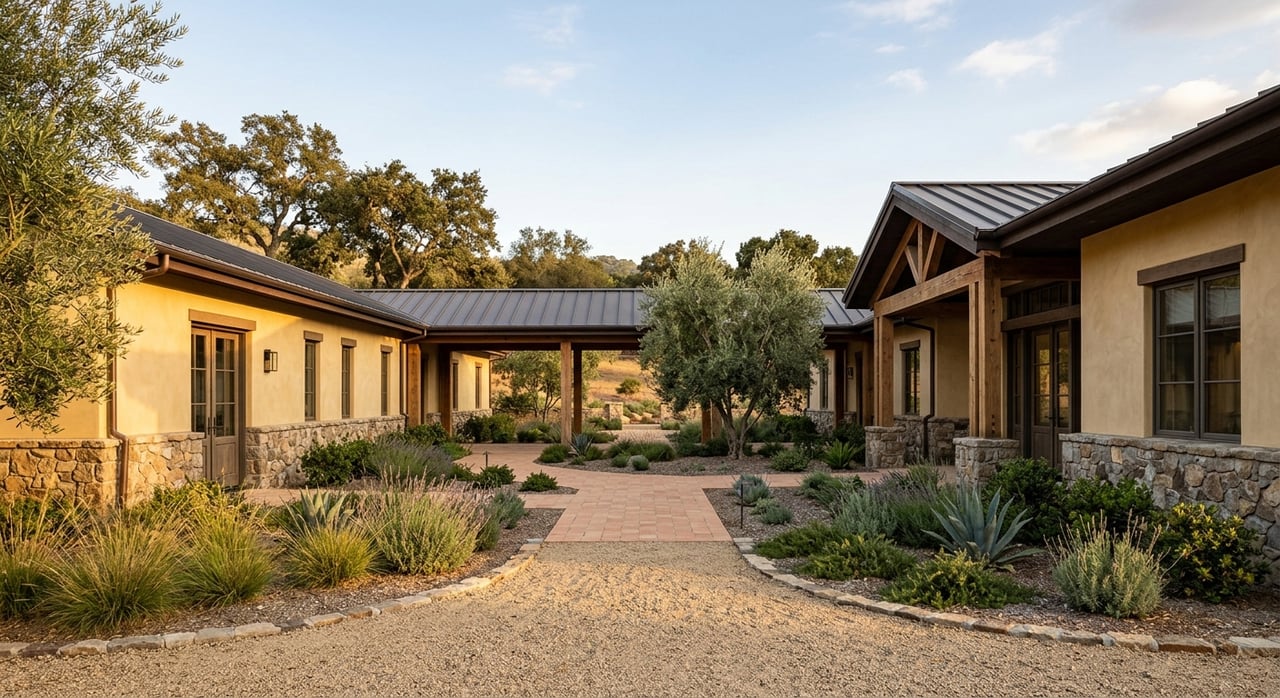
If you are dreaming about a multi-generational ranch estate in Calistoga, the vision probably starts with lifestyle: room for family, privacy for guests, and a home that feels rooted in Wine Country land. But in this part of Napa Valley, great estate design starts long before floor plans or finishes. The real work begins with understanding jurisdiction, land use, water, wildfire readiness, and what the parcel can legally support. Let’s dive in.
Start With Jurisdiction
In the Calistoga area, one of the first questions is whether your property is inside city limits or in unincorporated Napa County. That single detail can shape nearly every design and planning decision you make.
Within the city, the City of Calistoga Planning Division works under the city’s General Plan, zoning framework, and residential design guidelines. In unincorporated areas, county rules apply instead, and those rules are often more closely tied to agricultural preservation and open-space policy.
That distinction matters because Napa County’s General Plan is explicitly agriculture-first. It directs housing and commercial growth toward incorporated areas and designated urbanized zones, while protecting agricultural land with large minimum parcel sizes in many areas. If you are planning a ranch estate outside the city, your design has to respond to that broader land stewardship framework.
Define Multi-Generational Living Clearly
A multi-generational estate can mean very different things from one family to the next. You may want a main residence with a private wing for extended family, a detached home for parents, space for a caregiver, or flexible guest accommodations that support long visits without creating a full second household.
In Napa County, the right design strategy often depends on which type of secondary structure is allowed on the parcel. That is why it helps to define your needs early in practical terms, not just lifestyle terms. Privacy, independence, accessibility, and legal use all need to line up.
ADUs Offer Flexibility
For many Calistoga-area estates, an accessory dwelling unit, or ADU, is one of the most adaptable tools for multi-generational living. County guidance allows ADUs to be detached, attached, or created through conversion of existing space, and they may be established in residential, mixed-use, or agricultural zones.
That flexibility can support a wide range of family needs. An ADU may work well for parents, adult children, long-term household support, or a more private living arrangement that still stays connected to the main estate.
Guest Cottages Have Tighter Limits
A guest cottage is more limited than an ADU. In Napa County, it is defined as a detached sleeping structure without a kitchen, with a maximum size of 1,000 square feet, and one is generally allowed per legal parcel in RC, AP, and AW zones.
The county also states that the cottage usually must be within 500 feet of the main or secondary residence. In some situations, agricultural or environmental constraints may justify a waiver from the usual stand-alone or distance requirement, but the default standard is still an important site-planning factor.
Zoning Can Change the Whole Plan
If your parcel is in an agricultural zone, the zoning details become especially important. County planning materials note that in AP zoning, a primary residence of any size may be allowed with a guest unit, but AP does not allow a second unit. AW zoning, by contrast, does allow a second unit, which can make a major difference for a true multi-household estate concept.
This is one reason luxury rural properties require land-first analysis. What appears to be the same “Calistoga ranch estate” idea on paper may be feasible on one parcel and far more constrained on another.
Plan the Site Before the House
In Calistoga, site planning is not just a technical exercise. It is the foundation of whether the estate will function well over time. Access, water, wastewater, slope, and landscape layout all influence what can be built and how comfortably the property can support multiple generations.
When a parcel includes vineyards, agricultural ground, or hillside terrain, those issues become even more central. The site plan often needs to do much more than position a beautiful residence.
Water and Wastewater Come First
Napa County’s Environmental Health Division regulates wastewater treatment and disposal systems in the unincorporated county and on city parcels that are not served by public sewer. The division also reviews permits for water well construction and related land-use matters.
For a multi-generational estate, this means livability depends on infrastructure capacity as much as architecture. If you want multiple structures, outdoor living areas, gardens, or other water-dependent features, it makes sense to evaluate utility realities early.
The county’s Water Availability Analysis policy adds another important layer. Discretionary permits may be screened for impacts on groundwater, neighboring wells, and surface waters, and further site-specific analysis may be required when thresholds are exceeded.
Slopes, Drainage, and Creek Buffers Matter
On vineyard or hillside parcels, topography can strongly influence the design. Napa County’s Conservation Division reviews agricultural, vineyard, and development plans on slopes over 5% through the Agricultural Erosion Control Plan process, and it also addresses stream-related conservation issues.
That means drainage, slope stability, and creek setbacks should be part of your early estate program. Even a guest cottage may need to account for stream setbacks under county conservation regulations, so it is smart to think about the whole land system rather than treating these items as late-stage surprises.
Design for Wildfire Readiness
Wildfire planning is not optional in the Calistoga area. It is a central part of responsible estate design, especially for properties with larger acreage, hillside exposure, or long access drives.
According to the State Fire Marshal’s Fire Hazard Severity Zone program, hazard maps are based on vegetation, topography, climate, ember movement, crown-fire potential, and fire history. The state also notes an important distinction between hazard and risk: while a parcel may remain in a mapped hazard zone, practical exposure can be improved through defensible space and home hardening.
For Calistoga specifically, the city’s fire hazard severity zone information and wildfire mapping resources emphasize coordinated evacuation planning with Napa County agencies. For a multi-generational estate, that can influence driveway design, turnarounds, address visibility, emergency access, and how separate structures are arranged across the site.
Napa County also identifies defensible space as a frontline defense against wildfire and provides tools and resources to help owners understand hazards on their land. In practice, that often supports a more durable estate layout: simple circulation patterns, lower-combustion landscape zones, and thoughtful separation between structures and heavy vegetation.
Think Beyond Construction
A successful ranch estate is not just about what you can build today. It is also about how the property will perform over time as a family asset, a working landscape, or part of a longer legacy plan.
In Napa County, restrictions on use can affect value. The county assessor notes that zoning and conservation easements may influence property value, and these restrictions should be understood before you commit to a design concept that depends on future flexibility.
For agricultural parcels, the Williamson Act framework can also shape ownership strategy. County information explains that contracts generally apply to AP or AW parcels that meet minimum parcel size requirements and bona fide agricultural use standards, offering preferential property-tax assessment in exchange for preserving agricultural land.
Groundwater can also affect long-term costs. Napa County’s groundwater sustainability page notes that the Napa Valley Subbasin overlaps parts of Calistoga, and outside the city’s municipal service districts, some properties in the subbasin are subject to groundwater sustainability fees.
A Better Way to Approach Estate Design
The best multi-generational ranch estates in Calistoga are usually not the ones that start with the biggest house. They are the ones that begin with a careful match between family goals, legal allowances, land capability, and long-term stewardship.
That often means asking a smarter set of early questions:
- Is the parcel in the City of Calistoga or unincorporated Napa County?
- What zoning applies, and does it support an ADU, guest cottage, or second residence?
- Is there sufficient water and wastewater capacity for multiple structures?
- Do slopes, stream setbacks, or conservation rules limit the building envelope?
- How should wildfire readiness shape access, landscaping, and site layout?
- Will zoning restrictions, agricultural status, or groundwater fees affect long-term ownership?
When those answers come first, the architecture can follow with far more confidence. You end up with an estate that not only looks beautiful in the landscape, but also works as intended for family life, operational needs, and future ownership.
If you are exploring a Calistoga ranch or estate property, working with an advisor who understands parcel research, land-use constraints, and the realities of Wine Country development can save time and help you evaluate options more clearly. Jeff & Casey Bounsall bring a land-first perspective to complex estate and vineyard properties, helping clients assess what a parcel can support before major decisions are made.
FAQs
What can a multi-generational estate in Calistoga legally include?
- It depends on whether the parcel is in the city or unincorporated county, along with the zoning. In Napa County, options may include a main residence, an ADU, a guest cottage, or in some cases a second unit depending on the zoning district.
What is the difference between an ADU and a guest cottage in Napa County?
- An ADU may be detached, attached, or created from converted space and can function as a flexible housing option. A guest cottage is a detached sleeping structure without a kitchen, is limited to 1,000 square feet, and is generally subject to distance and zoning rules.
Why does jurisdiction matter for a Calistoga-area ranch estate?
- A parcel inside Calistoga city limits follows the city’s planning framework, while unincorporated acreage follows Napa County rules. Those systems can differ significantly in land use, design review, and development standards.
How important is water planning for a multi-generational ranch estate?
- Water planning is critical because multiple structures, landscaping, and other site features can trigger infrastructure and groundwater review issues. Wastewater treatment, wells, and water availability should be evaluated early in the process.
How should wildfire planning influence a Calistoga estate design?
- Wildfire planning should shape driveway access, defensible space, building placement, emergency circulation, and landscape choices from the beginning. In this area, wildfire readiness is a core design issue, not a final checklist item.
Can long-term ownership costs affect a Calistoga estate decision?
- Yes. Zoning restrictions, conservation easements, Williamson Act status, and possible groundwater sustainability fees can all affect value, operating costs, and long-term planning for the property.